What Is Revenue Optimization?
Revenue optimization means using strategies to increase total revenue and grow profit margins without compromising customer satisfaction. This approach enables service businesses and professional services providers to manage resources more effectively, identify areas for operational improvement, and streamline processes for sustainable growth. By understanding profit margin formulas and exploring different pricing strategies, companies can unlock new revenue streams while maintaining healthy margins, even as market conditions change.
Many of our customers are familiar with the rave reviews about our products, yet some are unaware of one of TimeLinx’s most impactful features—our Revenue Optimization engine. This tool is a key differentiator for TimeLinx compared to other project and service management (PSM) software. In fact, TimeLinx is the only PSM we know of with this capability, and your ERP system can’t match it. By integrating dynamic pricing techniques and addressing direct costs, operating expenses, and labor costs, this engine provides a deeper understanding of profit margins, helping you improve profitability and achieve stronger financial performance.
A core design requirement for TimeLinx was to reduce the complexity and time needed to track, improve, and measure real-time project profitability, while accelerating invoicing and cash flow. Managing a project is about making your customer happy and delivering work on schedule and within budget, but it’s also about ensuring the project is profitable for the provider. Delivering robust gross profit depends on smart allocation of operating costs and careful pricing strategy to maintain a strong operating profit margin. TimeLinx helps businesses calculate profit in real time, providing insight into profit margins and ways to reduce costs while still increasing customer satisfaction.
How can you maximize revenue—and profit—without cutting prices or hiring less costly workers? The answer is to generate more revenue from your current staff with the same billable hours. In other words, refine your pricing structure. In professional services, applying optimization strategies like gross margin analysis and dynamic pricing can increase revenue and improve profit margins. By focusing on operational efficiency and optimal allocation of labor costs, you can quickly improve your overall financial health and operating profit.
Over time, most of our customers have moved from simple pricing strategies to more complex, tiered models thanks to TimeLinx. These tiered models enable more precise margin management, account for direct costs, and optimize gross profit margins even in challenging markets. By tailoring services to each revenue stream, businesses can achieve higher profit margins and sustainable growth—far beyond what a one-size-fits-all approach allows.
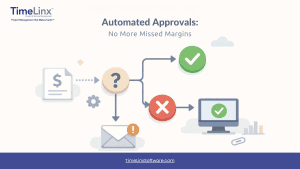
For example, instead of charging the same rate for a junior consultant versus a senior one or someone with specialized training, TimeLinx can adjust billing rates automatically. The same applies if work is performed on weekends, outside standard hours, out-of-scope, at a fixed rate (such as classroom training), or involves extensive travel—or any combination of these factors. These variables are based on previously agreed contractual rates. Many companies want this flexibility but cannot achieve it manually. Training accounting staff to factor and calculate all these scenarios for every invoice is nearly impossible, error-prone and time-consuming. By automating these rates, organizations not only strengthen their gross profit margin but also maintain a clearer picture of operating profit margin, improving profit margins over time.
One of our longtime customers had such complex services that it once took seven weeks to produce an invoice after work was completed. Their services could not be simplified, so accounting spent hours calculating each invoice from spreadsheets. Factoring in operating expenses, labor costs, and multiple pricing strategies made it even more challenging. Without a comprehensive solution, service businesses often struggle to calculate profit or maintain customer satisfaction due to administrative delays.
For most companies, managing this complexity manually is simply impossible. As a result, they resort to the KISS (Keep It Simple, Stupid) method and leave money on the table. Over the years, we’ve tallied this “table money” and the amounts are staggering. Missing opportunities to increase profit and failing to track operating costs accurately can significantly impact margins and financial health. Businesses find it harder to streamline operations, identify improvement areas, and maintain healthy margins when so much profit is left unrealized.
TimeLinx brings together all the requirements of project and service management—including Gantt charts, time tracking, expense management, scheduling, task and contract management, asset tracking, ERP integration (with optimized rates), mobile apps and more. By uniting these tools, TimeLinx supports revenue optimization strategies that help service businesses improve profit margins and increase profit by accurately assigning costs and capturing gross profit in real time. This holistic approach enhances operational efficiency and customer satisfaction by ensuring projects are delivered on time and on budget.
If you’re not familiar with our Revenue Optimization feature and see yourself in any of the situations above, contact us to discuss your needs. If you’re an existing TimeLinx customer who hasn’t implemented these features, call us and we’ll show you how. It will make a significant difference in your profitability. By applying these principles, companies can keep operating profit strong, reduce costs, and implement a dynamic pricing structure that fits their unique business model—helping you consistently increase revenue and maintain strong margins.
And what about the customer who once took seven weeks to generate an invoice? Today, ten years later, they’ve grown over 400 percent and invoices take just five days with TimeLinx. That growth illustrates how adopting revenue optimization strategies and robust pricing can drive higher margins, stronger financial performance and sustainable growth. By reducing invoicing delays, they saved time, cut costs and significantly boosted profit.
Happy Selling!